A Learning System Designed for Human Variation
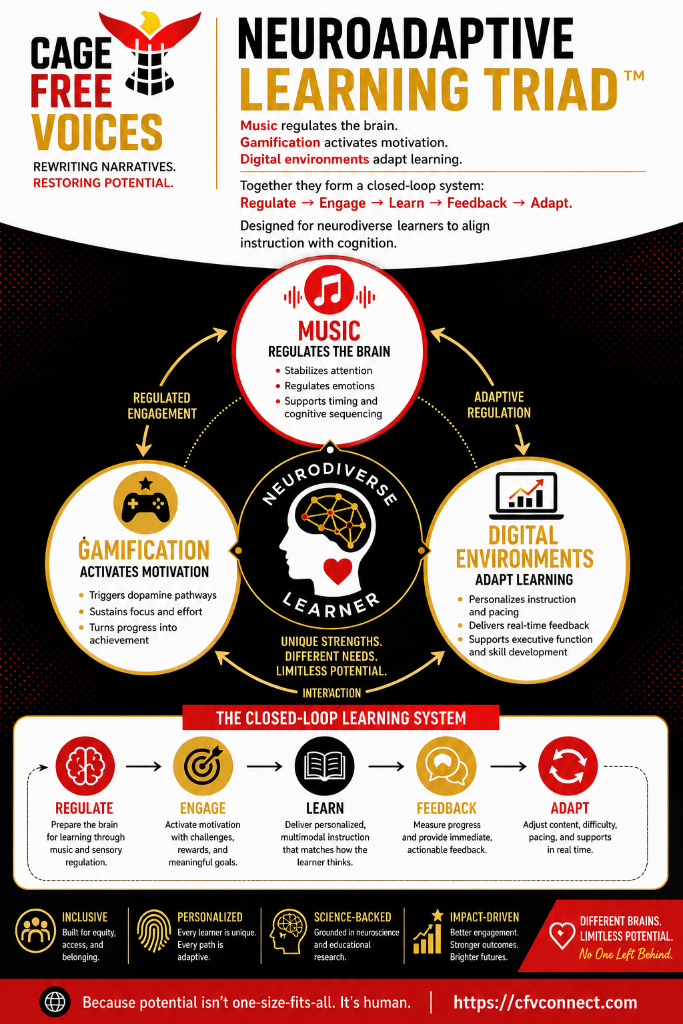
The Neuroadaptive Learning Triad™ integrates music, gamification, and intelligent digital environments into a unified system that regulates attention, activates motivation, and adapts learning in real time.
Traditional education systems assume standardized learners.
The Neuroadaptive Learning Triad™ is built on a different premise:
Learning improves when systems align with how the brain processes information.
Developed by Cage Free Voices, this framework redefines learning as a dynamic interaction between regulation, engagement, and adaptation.
Neuro-Inclusive Intelligence Systems
By The Queen Bathsheba · CEO & Founder, Cage Free Voices · May 6, 2026
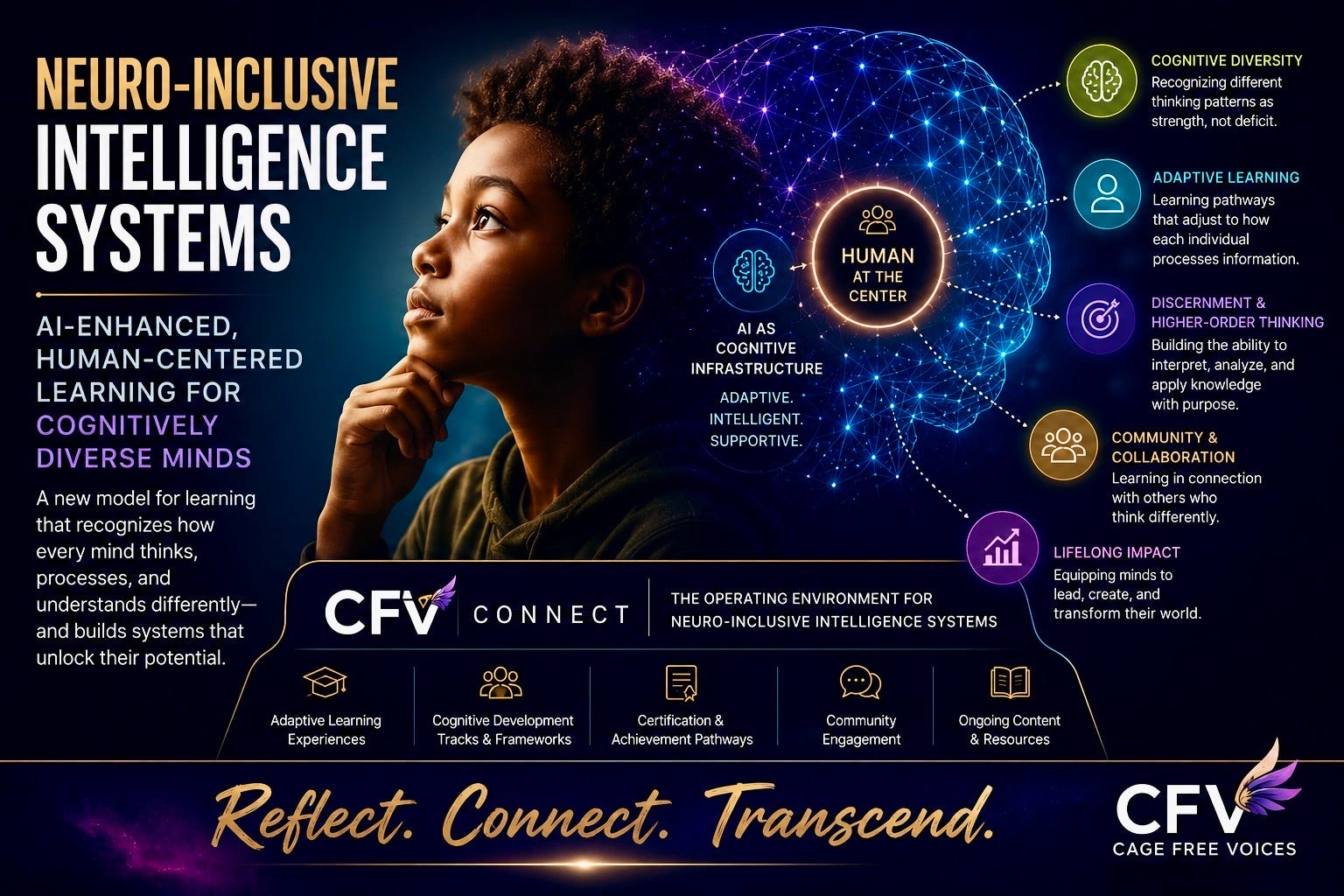
"AI-Enhanced, Human-Centered Learning for Cognitively Diverse Minds"
There is a structural failure unfolding in education systems that is being widely misunderstood. It is not simply a technology problem, nor is it a curriculum problem. It is a failure of the underlying model of intelligence that modern education was built upon.
That model assumed cognition could be standardized, measured uniformly, and optimized through repetition. It worked in an industrial era. It does not survive in an AI-driven one.
Artificial intelligence has not disrupted education by replacing teachers. It has exposed a deeper truth: most educational systems were never designed for intelligence development — they were designed for behavioral consistency.
The Collapse of Standardized Cognition
For over a century, learning systems have been built around a narrow assumption: that intelligence is linear, uniform, and universally teachable through standardized instruction. This assumption has always excluded cognitively diverse minds — individuals whose thinking patterns do not conform to linear processing, repetition-based retention, or standardized evaluation structures. These learners were not failures of the system. They were evidence of its limitation.
Artificial intelligence accelerates this revelation. When machines can generate, summarize, and compute at scale, the value of human cognition is no longer defined by replication. It is defined by interpretation.
Neuro-Inclusive Intelligence Systems
A Neuro-Inclusive Intelligence System is not an educational method. It is a cognitive infrastructure model designed to operate beyond standardized instruction. It recognizes that intelligence is not a uniform capacity, but a distributed range of cognitive architectures that require differentiated engagement. Its foundation is simple: human intelligence is not standardized. Therefore, learning systems cannot be either.
Within this framework, learning is not delivered through uniform pathways. It is structured around cognitive diversity, adaptive interpretation, and meaning-based processing. The goal is not content absorption. The goal is cognitive development.
AI as Cognitive Infrastructure, Not Instruction
In this model, artificial intelligence is not positioned as a replacement for human instruction. It functions as adaptive cognitive infrastructure. Its role is to reduce mechanical friction in learning environments so that human cognition can be directed toward higher-order processes: interpretation, synthesis, discernment, and reasoning under complexity.
This shifts the function of education away from information delivery and toward cognitive refinement. The machine handles scale. The human handles meaning.
Cognitively Diverse Intelligence as a Core Asset
Cognitive diversity has historically been misclassified as deviation from a norm. In reality, it represents variance in processing architecture, not deficiency in capability. Systems that fail to recognize this variance suppress intelligence rather than develop it. Neuro-Inclusive Intelligence Systems are designed to reverse that dynamic by aligning learning structures with cognitive variation rather than against it.
From Educational Model to Cognitive Infrastructure
Traditional education systems function as content distribution models. Neuro-Inclusive Intelligence Systems function as cognitive infrastructure systems. This distinction matters because infrastructure does not deliver information — it shapes capability. This model extends beyond schooling into broader domains: cognitive training, leadership formation, interpretive reasoning systems, and adaptive learning environments. Its purpose is not to produce standardized outcomes. Its purpose is to develop adaptive thinkers.
The Strategic Shift in Intelligence Value
As artificial intelligence expands access to information and execution, the economic and cognitive value of human intelligence shifts. The advantage is no longer in what is known. It is in what can be correctly interpreted under complexity. Neuro-Inclusive Intelligence Systems operate in the second category — designed for environments where information is abundant, but discernment is scarce.
Closing Principle
The future of learning will not be defined by access to information. It will be defined by the design of cognitive environments capable of developing discernment at scale. Neuro-Inclusive Intelligence Systems represent that shift. CFV Connect is where that shift is operationalized.
The Triad
Three layers. One unified system.
Music
Music functions as a cognitive regulator, stabilizing attention and modulating emotional state.
- Supports focus and timing
- Reduces cognitive overload
- Prepares the brain for learning
Gamification
Gamification activates motivation through structured challenges and feedback loops.
- Sustains attention and effort
- Converts progress into achievement
- Increases persistence and confidence
Digital Environments
Intelligent systems personalize learning based on real-time interaction and performance.
- Adjust pacing and difficulty
- Provide immediate feedback
- Support executive function and task completion
A Continuous Learning Loop
This creates a responsive environment that evolves with the learner in real time.
Music regulates cognitive and emotional readiness
Gamification drives engagement and sustained focus
Digital systems deliver personalized instruction
Feedback informs continuous system adjustment
The system evolves with the learner in real time
14-App Learning Ecosystem
Your assessment generates a personalized learning stack drawn from 14 connected apps, filtered by your grade band and cognitive profile.
Audio & Language Regulation
- Phoneme Beats
- Write Move ABC
- CFV Camps
Gamified Learning Systems
- CFV Adventure Lab
- AlgebraQuest
- CFV Numeris
- FirstGen Pioneers
- Weight of the Crown
- C.H.A.P.S Vlog
AI Supported Human Instruction
- CFV Online Learning
- ClassConnect
- CFV BioNexus
- The Quill & The Keyboard
Discover Your Learning Profile
Take our 18-question neuroadaptive assessment and receive your personalized cognitive profile, grade-specific 14-app learning stack, and pathway assignment — in under 3 minutes.
Then verify ClassConnect enrollment to unlock your full dashboard.
No account required. Your profile is generated instantly.
Neuroadaptive Discernment & Support Pathway™
A non-invasive alignment assessment across four cognitive domains: Neurological Functioning, Environmental Alignment, Developmental Trajectory, and Identity & Self-Agency. Outputs are read-only guidance signals — not labels or diagnoses.
Sign in to access the NDSP™ assessment.
Educational Use Disclaimer: The Neuroadaptive Learning Triad™ is an educational personalization framework. It does not diagnose medical or psychological conditions, guarantee learning or performance outcomes, or replace professional educational or clinical guidance. All outputs are algorithmic interpretations of self-reported responses. Cage Free Voices assumes no liability for interpretation or use of results.
Experience the System in Action
Visit CFVConnectBecause potential isn't one-size-fits-all. It's human.